
Is Legacy of Dead Legal to Play?
The legality of playing Legacy of Dead depends less on the slot title itself and more on the gambling rules in your country or region. Online casino law varies widely, so the key question is whether the platform, the local regulations and your age or eligibility all align before you start playing.
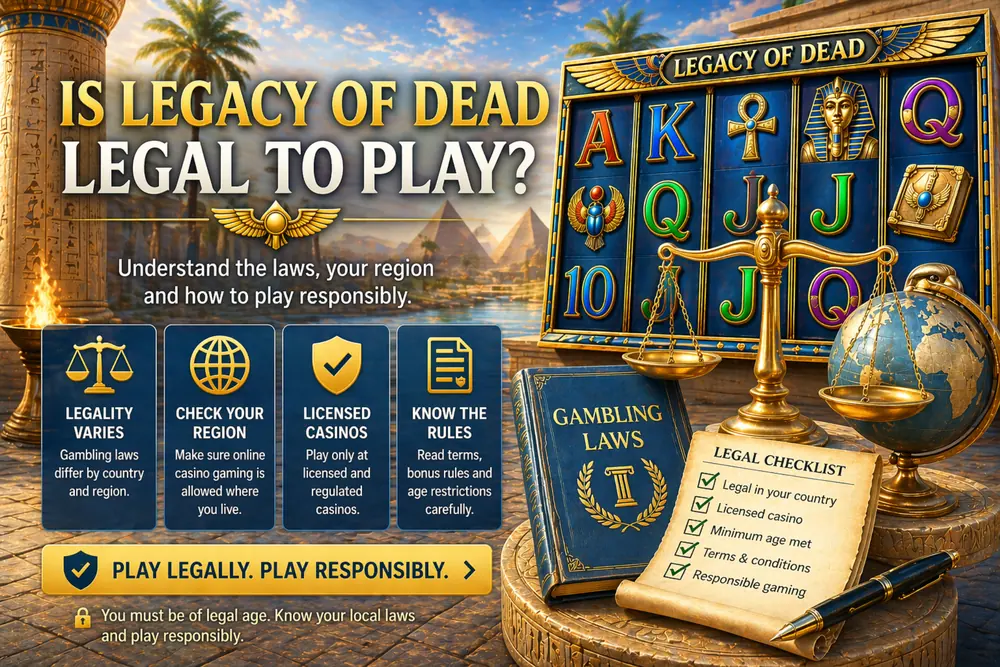
Is the game itself legal?
Legacy of Dead is a mainstream slot title, but legality is not defined by the game name alone. In most cases, the real legal question is whether online casino gambling is allowed, regulated or restricted where you live, and whether the casino offering the game is authorised to operate in that environment.
This is why the same game can feel straightforward in one market and more complicated in another. The slot may be available internationally, but the user’s location, the operator’s licence and local law are what actually determine legal access.
Legal status is regional
The safer assumption is that legality varies by jurisdiction. Always check the rules that apply in your own country or region before using a real-money casino.
What usually determines legality?
Your country or region
Gambling laws differ widely. Some markets allow online casino activity openly, some regulate it under specific licences, and others restrict or complicate access.
Casino licensing status
Even if online gambling is permitted, the platform itself may need proper licensing or legal standing for that environment. A recognised operator is usually a better baseline than an unclear one.
Age and eligibility rules
Legal access is not only about geography. Minimum age requirements, account verification and eligibility standards are also part of lawful participation.
Local payment and compliance rules
In some places, payment rules, identity checks or operator restrictions shape whether real-money access is practical or legally supported.
What should you verify before playing?
If you are unsure whether Legacy of Dead is legal to play where you live, these are the first practical checks worth making:
- Check whether online casino gambling is allowed in your jurisdiction.
- Confirm that the casino clearly displays licensing information.
- Make sure you meet the legal age requirement.
- Read the casino’s terms, payment rules and eligibility conditions.
- Avoid assuming availability automatically means legality.
A game being visible online does not always mean it is legally suitable for every user in every region.
How to think about legal risk more realistically
Many players reduce legality to a simple yes-or-no label, but the reality can be more nuanced. Some markets are clearly regulated, some are partially restricted and some operate in a grey area depending on the operator, payment flows or enforcement model. That is why personal verification matters more than broad assumptions.
The most sensible approach is conservative: if the legal position feels unclear, do more checking before proceeding. This is especially important for real-money play, where account verification, withdrawals and compliance rules can become relevant very quickly.
Related pages for trust, access and control
This page works best inside the wider EN cluster. These related guides help connect legality with trust, platform choice and safer behaviour:
Verify the rules before you play
If you plan to try Legacy of Dead, make sure the legal position is clear in your region, use a trusted option and approach real-money play with full awareness of local rules.
FAQ
Is Legacy of Dead legal everywhere?
No. Legal status depends on the gambling rules in your country or region, as well as the status of the casino offering the game.
Does availability mean the game is legal for me?
Not always. A game being accessible online does not automatically mean it is lawful or appropriate for every jurisdiction.
What should I check first?
Check your local gambling rules, confirm the casino’s licensing details and make sure you meet the legal age and eligibility requirements.
Is real-money play more sensitive legally?
Yes. Once deposits, withdrawals and identity checks are involved, legal and compliance issues usually become more important.